Sunday, March 6, 2011

Report from the Gasparilla Race Weekend


I am writing this race report because I can't walk anywhere on the saucer-sized blisters on the balls of my feet. (Apparently too large running shoes are just as bad as too small.)

The fire ant bites on the other side of my feet are less swollen and itchy now. (It is not a good idea to wear sandals in the sea grass duck watching at dusk.)

The flu which overtook me the day after flying to Florida has subsided.

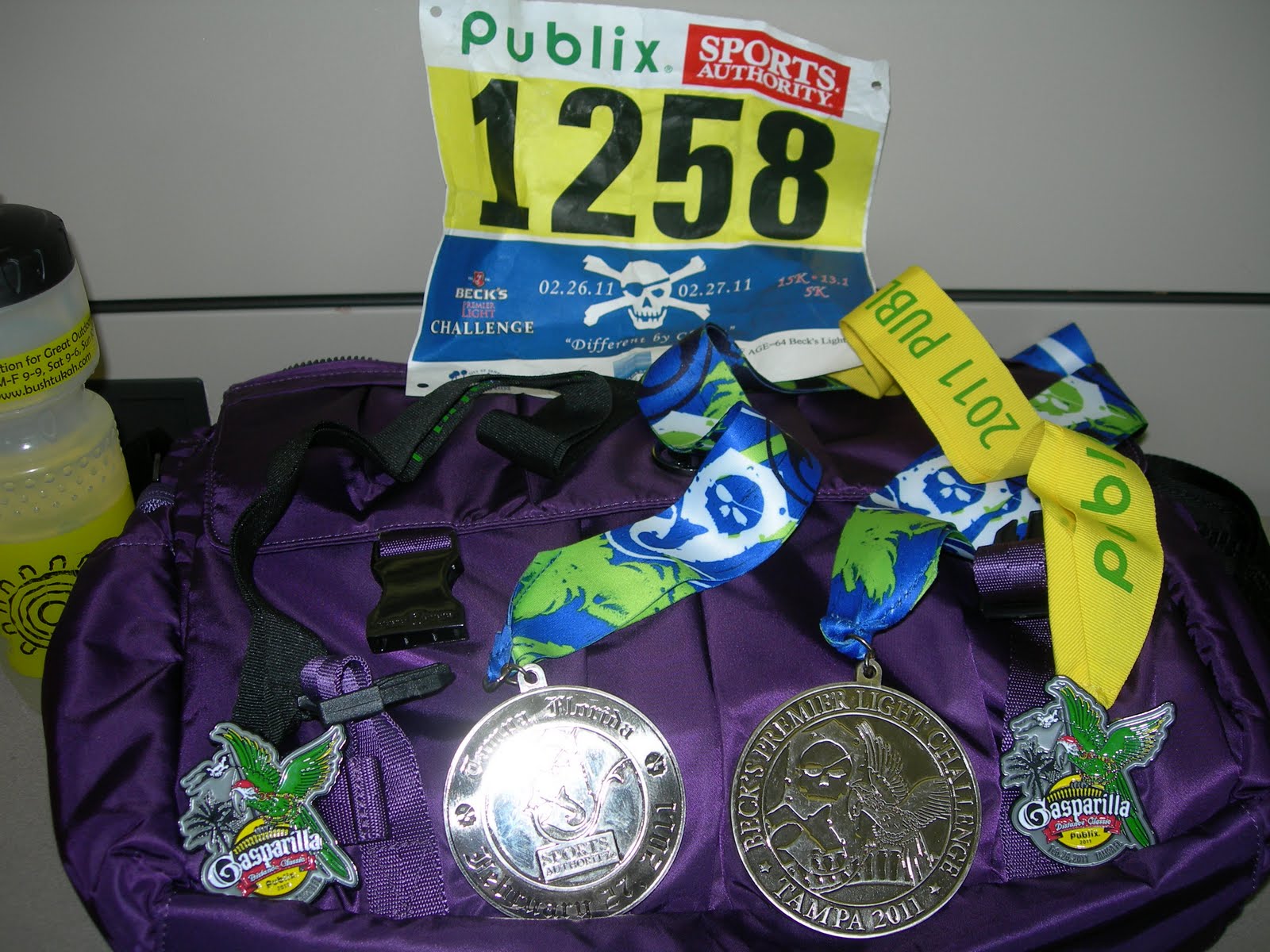
And in spite of it all, yesterday in 80 degree weather, I completed the first ever Beck's Light Ultra - the 15k, 5k and 21k races at the longstanding Gasparilla Race Weekend along the Tampa Bay waterfront.

What matters is not the apparel (three different race shirts plus a Beck's Light fleece vest) - or the three clanking race medals plus a heavyweight Beck's Light medal - it's the fact that I got up at 4:30 a.m. and sweltered through, a week after the frigid Winterman in Ottawa.

I'd always said I'd quit rather than suffer, but apparently that's not the case. It's fun to still be surprising myself.

Thursday, January 13, 2011

A Breeze from the Wind-Swept Iles de la Madeleine


Last spring, my friend Kristin Goff said she was interested in doing a one-week Cruise and Cycle package up the St. Lawrence River from Montreal.
She signed up, sharing a cabin with our friend Lynn Campbell. I signed up, sharing a cabin with cycle tour veteran Lorne.
Following is a quick report on written on our trip from CTMA (www.ctma.ca):
Les Iles de la Madeleine (a.k.a the Magdalen Islands) are about 100 km north of Prince Edward Island in the middle of the Gulf of St. Lawrence. The archipelago is made up of a dozen islands, and six of them are linked by long, skinny sand dunes. (As described in the guidebook, the Islands take the shape of a half moon fishhook stretching across a distance of 65 km in a south-west/north-easterly direction.)
The postcards don’t do justice to the red cliffs, sand dunes, brightly painted houses and saphire water.
Jacques Cartier praised the landscape in 1534, and there was fishing and hunting for seal and walrus long before he arrived.
The large ferry boards in Montreal on the Friday, day 2 in the Gaspe and then days 3, 4 and 5 docked in Les Iles de la Madeleine, day 6 back in Gaspesie Peninsula, day 7 in Quebec City and then day 8 back to Montreal. A GPS map posted near reception shows where the boat is at all times.
The package includes cabin accommodation for seven nights, 14 meals on board, light lunches for the road, and transportation for one bike per passenger.
To sum up, the scenery was spectacular, the cycling fantastic, the ship exciting (we’d never been on a cruise before), and Les Madelinots (the people) helpful and gracious.
For example, we’re cycling down Rue Coulombe towards Micro Brewery a l’abri de la Tempete, when my bike goes clunk. As Kristin and I examine the chain, a white-haired woman in navy pants and t-shirt immediately comes running out of her house to help. She turns the bike upside down, determines the problem is a missing screw holding the pannier holder to the bicycle, which has caused the metal rod to jam into the chain. She opens her car trunk for her tool box of hundreds of screws, fixes the rod, and apologizes that the screw is not the right colour.
It was the same whenever we stopped to look at a map; people came over without being asked. 
2 .m. Meeting 1 in the Red Lounge. Fruit punch in plastic glasses, and a demonstration how to use the life jackets.
Shortly after boarding Friday afternoon in Montreal, we are tapping our feet and sipping margaritas as we sit in the lounge and watch through rain dappled windows as the ship sails past La Ronde and other Montreal landmarks towards Trois Rivieres. (There are traditional musicians on the ship all week; we’re never up late enough to watch them.)
Forgotten are the wrong turns and humidity as we sweated our way from Ottawa to the port of Montreal to weigh anchor.
Lynn and Kristin are housed in a Lilliputian interior bunk bed cabin with no storage, but a private toilet and shower. (One foot’s in the shower when you’re in the toilet.) We (I) anticipating space deficit have chosen an exterior cabin with a porthole, also bunk beds, but slightly larger. We have to share bathrooms and showers with the other passengers on our cabin row. It was dicey for a couple of days when the toilets on our row weren’t flushing and the shower wasn’t draining, but once things were back to normal it wasn’t so bad.
The boat has massive public areas, prompting Kristin to muse why they couldn’t have given a little more space to the cabins and less to the lounge areas.

5 p.m. Meeting 2. For English participants only.
A rum cocktail in a plastic glass.
We are on Madeleine Islands time for the trip; we set our watches (with difficulty) to the Atlantic time zone, an hour ahead.
The aimof the English get-together is to wish us a good time and to show the ship cares about les Anglophones.
C.T.M.A.has been offering these trips for nine years; this week is a record number of English-speakers(60) because of a group of 30 from Collingwood, Ont.
There are over 300 passengers on the boat altogether. Around 97 per cent of the crew of 100 are from Les Iles de la Madeleine, and the rest are from Gaspe. This spring, they have been taking English lessons, and we are invited to see the two best English speakers if we have any communication problems with the crew. They have a mission this year, we are told, to improve the English product.
When we booked our trip, we chose the 5:30 p.m. seating for dinner rather than 8 p.m. The dining room has white table cloths.
People are dressed neatly, but not the “formal” suggested in some of the literature. Because tables are for four, it is noted that passengers will be “coupled” at dinner.
Since we had our own table for four, we weren’t “coupled” with anyone else. We did meet other people over breakfast and lunch.
The dinners on the ship are consistently excellent, with two choices each time.
The first night choices were seafood pot-en pot or bison medallions in cognac sauce, with of course an appetizer and a soup, and a chocolate caramel mousse cake for dessert.
One night the meal was large fresh local lobster, with turnip maple soup and blueberry cake. It’s like sitting in a revolving restaurant to be sitting backwards as the scenery and occasional whale goes by.
7:45 p.m. Meeting 3. Cycling people.
10 a.m. Meeting 4. More specific, cycling people, separate meetings for English and French.
We are told that each day we will see a different part of the Islands, on a self-guided tour. At 10 a.m. on Sunday, and 8 a.m. other mornings, we will meet with Fanny, Sebastien or Celine of Bureau Vert et Mer Ecotourism who will explain the day’s itinerary and give us a lunch bag and if necessary a time we’ll be picked up to return to the ship.
Daily direction depends on the prevailing wind; they will drive us out, to return on our bikes with the wind at our back. If we want to buy cheese at Au Pied-de-Vent Cheese Factory at Havre-aux-Maisons, they will store it for us until we leave the ship.
We cycle the South Island Sunday, the East Islands Monday and the Central Islands Tuesday. Distances are modest. The South Island is a 35k itinerary, with an optional 20km additional tour of Bassin. The East Islands is 65 km, but with four possible pick-up points before the final destination, Grand Entree, and return to the ship by bus.
The Central Islands is about 20 km, through the villages of Fatima, Etang-du-Nord and Cap-aux-Meules.


The ship’s dining room is closed while we’re docked on Les Iles, and we eat dinner on the Islands. Ship breakfast is cafeteria style.
After the heavy dinner and meetings, we collapse on deck on plastic Adirondack chairs to chat, inhale the sea breeze and swivel our heads around the expansive horizon. That’s one big river. The clouds are still gray and sky overcast, but the rain stops.
I spend the first night sweating in my humid top bunk, listening to something rattling, and people talking non-stop on the deck outside the window. Throughout the night the ships foghorn blasts intermittently, and each time I push the illumination button on my watch to see what time it is, so I won’t miss the 6 a.m. whale watching on the foggy, rainy deck. A light outside our window ensures 24 hour illumination of our room.
I show up at 5:55 a.m. in my green rain jacket to find we’re behind schedule, and won’t reach whale territory for at least an hour.
There are some people sleeping under blankets on the soft two-seater cocoa brown comfy couches by the windows. Others perch with their styrofoam coffee cups on the white window sills and gaze hypnotically at the overcast sky, shoreline and water, all complementary shades of silver. It’s beautiful in an arctic kind of way, all cold tones of white and gray.
Yoga after breakfast was so popular a second class was added for 2 p.m. to accommodate overflow. Yoga again a few days later on deck in the sunshine was a real sun salutation.
11 a.m. Navigation Meeting, because Wheelhouse Tour cancelled because of fog.
3 p.m. Meeting 6. Highlights of the Islands briefing.
Red Lounge. Bagosse fruit wine, 35 % alcohol.
On Saturday afternoon the sun comes out and we all flock to the deck chairs on the top deck to watch the water. The breadth of the St. Lawrence is awesome.
Sunday night, the foghorn blasts into our window again, and we awake to a sea of tin gray, with no visibility beyond some choppy dark waves beside the boat. Before we left, Lorne asked if he should put the batteries in the bike lights. I said we wouldn’t be cycling after dark. I didn’t even think about cycling in day time fog, however my yellow and blue jersey is bright enough to function as a fog light.
Sunday morning we board a bus to the South Island so we can have the wind at our back. Pelting rain cuts short the sightseeing, and visibility, but the route crossing Havreaux-Basque Lagoon through sand dunes and roadside wild flowers and beaches was magnificent despite the rain.  
(When we loaded at the ship in Montreal, Lorne’s tire had a flat, and then it blew up, in a series of complications.
Because it was Sunday when we arrived, the Island bike shop was closed. Sebastien, the bike coordinator for the tour, loaned Lorne his personal bike for the day.)
Monday is a magnificent day, point to point along the East Islands, with the wind at our backs. Stop for a self-created lunch at Au Pied-de-Vent Cheese Factory, a melange of cheese curds, French bread, and huge “crazy cookies” from nearby Helene des Isles Bakery, plus the assortment of juice boxes, raisin and nut mix, granola bars, oranges and apples provided for cycling each day.
Dinner at Vieux Couvent Restaurant, in an old convent overlooking the water, where the food and the service are unexpectedly as stylish as downtown Toronto.
Tuesday no shuttle is necessary, because the Central Island is where the ship is docked. Stunning blue sky and sparkling water as we circle via the shoreline, eating our pannier lunch outside at La Cote, a public park overlooking L’Etang-du-Nord fishing harbour and its little shops selling kites, crafts and locally made souvenirs.
Wednesday, breakfast on the boat at 6:30 a.m. and then we board a bus at the Chandler dock forPerce, the town and the famous rock, 45 minutes away. Town is an artist colony, rock and Bonaventure Island are noted for thousands of Northern Gannets who nest there. Our tour guide is folk singer and musician LucieBlue Tremblay who serenades us as we return. Rain and fog, but that big rock is hard to miss.
After our visit to Perce Rock, there’s an announcement telling everyone to gather in the lounge for a compulsory meeting. We all mutter and joke with apprehension.
We’re told that a labour lock-out at the Port of Montreal will be preventing us from docking there Friday.
We’ll be docking instead at Trois Rivieres, and then bused back to Montreal.
We all line up to hand in our car keys so our cars can be moved out of the Montreal port building where we left them, to an outside site. Bikes will be transported to Montreal by trailer. There are separate lines for people with and without cars, and those going farthest after Montreal got first bus preference.  
Free wine at dinner for our inconvenience.

We arrive at Quebec City Old Port at noon Thursday, and spend a beautiful sunny afternoon. Kristin and I cycle on the Quebec City bike trail, well mapped, along the shoreline, not hilly, while Lorne and Lynn stroll around the Old City. Another fine dinner back on the ship, plus more complimentary wine.
At 11 p.m. our boat time, 10 p.m. Quebec City time, we watch a huge 400-years-of-Quebec-City light show projected on port buildings, and then at 1 a.m. our boat departs for Trois Rivieres.
Around 8 a.m. we leave the ship in Trois Rivieres and we and our luggage board buses for the two-hour drive back to Montreal.
The Islands are not surprisingly a bit like Newfoundland, a bit like P.E.I., a very relaxing escape.
The Iles de la Madeleine logo is a clothesline, and a fitting common image is an engraving of a barrel with a sail that carried Island mail to Nova Scotia in February 1910 when the Islands lost contact with the mainland because of a breach in the underwater telegraph cable. Just like now, when we had no Rogers service for our cellphones or BlackBerries.

Tuesday, October 21, 2008

A for Amsterdam


Goedemorgen from Amsterdam, time delayed after an internet-free two weeks.

Lorne and I were on a Netherlands cycle trip, but before and after we spent time in Amsterdam, and here are some of our memories of that time...

Amsterdam is named after the Amstel River in the 13th century. 200 years ago Amsterdam became the capital of the Netherlands.

We flew KLM Montreal-Amsterdam direct, with a KLM bus to take us each way from the Ottawa train station to Montreal. The KLM flights, food, service, were excellent (except for Kung Foo Panda as the in-flight movie).

We were waiting at the Ottawa train station with a tall older Dutch woman from Arnprior. When she saw us again at the airport, she beckoned for us to join her for the cart ride through the terminal to the departure gate. Wheeee.
Waiting for the flight, I hesitated at the snack bar over what kind of tea to order. The well-pierced teenage server with a ring in his lip told me, “Green tea. It’s the healthiest. Lots of antioxidants.”
At the Montreal airport there were footstools on some of the seats in the waiting area, making it easier to actually rest.
Aug. 26
With a headwind, we arrive a half hour early and are at the Ibis hotel by 7 a.m. Amsterdam time. It’s a very, very tiny room, but a short walk from the train station and handy to everything. The hotel is across from a two-storey bike parking lot with thousands of bikes, and because we’re near the train station, there are thousands more bikes for blocks around.
Weather is typical Amsterdam, cool, cloudy, drizzly.
Grazing walk around for snack bar meals including falafel and sushi (Louise) and herring sandwich, cheese sandwich and two Heinekins (Lorne).
Argentinian steak restaurants and shawarma places exceed all others.
Aug. 27

Take a city tour. Wait for the lift bridge to go down near the site of new central library built two years ago, and the Tower of Tears from centuries ago where women and children cried as men went to sea.
More cyclists than cars wait at the bridge, riders on spray painted bikes, wearing high heels, suits, dressed for work. Bike lanes, bike parking everywhere. New architecture as interesting as old, plus new uses for old shipping warehouses. There are more than 1300 bridges, many dating from the 1600s. It’s like Venice, only Amsterdam has moved on into the 21st century.

17th century botanic garden... “Skinny Bridge” built by two sisters living across canal from each other in 1670 and didn’t want to boat in... Floating flower market...

The bus tour includes a visit to a “Diamond Museum” which is like Amway. You get in there, and they lock the door of the room for 20 minutes while they try to sell you diamonds.


Touring the Diamond Museum we were the only English speakers (rest were Spanish) and on the canal boat,all but us were Russian.

In the afternoon we went to the Rijks Museum to see masterpieces by Vermeer, Rembrandt etc from the Dutch Golden Age, the 1600s, and the took a canal boat cruise. There are ferries that go back and forth every 12 minutes, for pedestrians and cyclists only, and they are free. Saw houseboats, tall ships, all kinds of boats.

There are 2,500 houseboats in the city, many illegal. They live year-round on the boats, paying the city a fee. Many have flower boxes and plants along the deck. One had a sign “See what a houseboat looks like inside” and they made some money.

The railings along the canals are there to prevent cars from going into the water, but there is still a special dredge unit only to get cars out of the canal.The railings are owned by the insurance companies, not by the municipal government.

The boat guide said there are 725,000 people in Amsterdam, 42 per cent of non-Dutch ancestry, and 50 per cent one-person families.

Walking back from the boat, we stopped for pannenkoeken (pancakes). Lorne had Appel (apple) and I had Kaas (cheese). My second choice would have been Citroen (lemon.)

Still no sun. It feels like Whitehorse in November to wake up in the almost dark and to continue that dullness all day. People dress in black and gray.The only splashes of color are the spray-painted pink and fluorescent orange bikes which stand out among the racks of black bikes, some dotted with leis or fake leaves for identification.

Aug. 28
Take the bus to Brussels an Antwerp. Just tell me why the “Manneken Pis”, the peeing boy fountain, is so popular there are crowds around it all the time. Hundreds of ‘boy’ souvenirs from chocolate suckers to bells and statues for your garden.
Had lunch of moules et frites (mussels) at a cafe overlooking Brussels’ beautiful main square.
Bus got caught in a traffic jam on the way to Antwerp because of a tunnel accident, and we sat still in traffic for hours, coloring our impression of Antwerp. Some old buildings, a long waterfront, and a McDonald’s handy as always when you need a bathroom.

Aug. 29
Spent the morning visiting the rosebush lined village of Watergang outside Amsterdam, home for 50 years to our friend Puck’s mother.
It’s a tiny, Thomas Hardy-like hamlet with sheep, ducks, roosters and a canal. She took us for a walk along the cobblestones by the water and we had lunch at the De Wetgmijzer restaurant beside the street. She says the small red clay roofed houses in Watergang now go for over $1 million because it’s so serene and yet 10 minutes by frequent bus from Amsterdam. She didn’t like the village back when her husband chose it, but she’s happy at 90 to be there now.

We leave Amsterdam for our bike trip and continue our exploration a week later...

Sept. 5
We visit the Jewish Historical Museum, part of a complex of four restored synagogues including the Portuguese Synagogue from the 1600s. (In 1492 Spain expelled its Jewish population. Many fled to Portugal but were forcibly baptized. More than 100 years later, descendants of those victims of the Inquisition who wanted to live as Jews began to arrive in Amsterdam. Since the Dutch Republic was at war with Spain, they called themselves “Portuguese Jews” to avoid being identified with the Spanish enemy.

Letting everyone in to the country in the 1600s was for economic reasons, but it set the precident for Dutch liberalness in future.

The synagogue was undamaged even in the 2nd World War and is an amazing building with giant brass chandeliers that hold 1,000 candles, the only lighting in the unheated building.

The historical exhibit includes moving paintings and drawings of the early days by artists of the time. There is an excellent oil painting of a poor, sad old Jewish man sitting on the stoop of his shop. It was so popular that prints were made, but the commentary said the Jewish community was upset and asked why a young, attractive, well-off Jewish person couldn’t have been portrayed instead.
--
We have also of course gawked curiously at the “dark” Amsterdam nightly information tours offered by a former prostitute. The sailors are gone; the area is safe, the pamphlet says. We walked past the street level windows illuminated by dark fluorescent light where women wearing little beckon men on the street. We saw several go in the adjoining door to be led to the back.

There are also lots of “coffee houses” which are marijuana cafes, where people sit on cushions in the windows and smoke from hookahs, and weed and seed shops selling cannabis lollipops, starter kits for plant growing etc.

Sept. 6
We walked the city all day, spending time in The Rembrandt House where he lived 1639-1656, until he went bankrupt.There was a list of his possessions and all has been re-created with furniture from the time, including the short box cabinet bed - because people sat up to sleep so the blood wouldn’t leave their heads.

The most impressive thing again about Saturday night in Amsterdam is that once again the sidewalks are full, the cafes are packed, the bike lanes are busy and there are almost no cars on the streets, just a few taxis.

Sept. 7

Sunday morning and rain and wind again, ignored by the many walkers and cyclists. We walk for the last time down the Bloedstraat Red Light District, with only a few lights on and windows occupied - an( unreciprocated) hopeful wave and smile to Lorne; down the Chinatown streets with notices in Dutch not to lean your bike on the windows, past the flea market stalls, with mostly African textiles, carvings and jewelry, and all the while the church bells chime across the city.

We walk from our hotel to the train station for our train ride to the airport, the end of two weeks without entering a car.

Tot Ziens (Goodbye) and Proost! (Cheers!)

Go-go-go!: How a herd of cats became a peloton


Thursday night in Amsterdam, a few blocks from the Red Light District, a dozen cycle tourists are joking round in an Italian restaurant and presenting each other with mock awards...

There’s the Gold Tulip Grease Monkey Award to Paula, wife of group leader Manny Agulnik, who managed to adorn her calves with black tracks daily; there’s the the True Grit Award to Rick Day for wiping out and still smiling, the Fashion Victim Award to Barry Wishart for his orange cycling jacket purchased in Delft, and assorted Bad Hair Day, Most Improved Cyclist and other awards to the rest of the gang, age range early 40s to late 60s who had just completed a six-day cycle excursion before which most of us were strangers to each other.

Participants Barb and Barry Wishart of Scotchtown, New Brunswick, are the sister-in-law and brother of Heather and Byron Landry of Ottawa, where the rest of us originated.

This is the fourth year for Manny Agulnik’s guided leisure cycling tours of the Netherlands. The Ottawa cycling proponent was so enamored by this cycle-friendly country that he wanted to share it with others. He puts together packages including rental bikes and hotels and his leadership; we get to Amsterdam by our own means.
Next year he’s adding a cycle tour in Denmark to his offerings.

Here’s a round-up summary of our adventure at the end of August 2008:

Day 1
The 12 of us tram to Mac Bike, the bike rental location, with our luggage and then spread out on the ground to fill our panniers. We leave the rest of our stuff in the Mac Bike back room, and practice going around the building on our bikes with loaded panniers. Some adjustments, some tipovers, and our line is heading through the city on our way out to Utrecht.

When the bike signal is green, we push forward to cries of “Go, Go, Go!”, but the light is short, and the back end is usually caught on the red and we have to wait.

A few minutes into the ride, we all stop again because Rick’s handlebars are too loose, and he can’t control his bike. We wait in the park while he and Byron use the Allan key and then we’re on our way, on a beautiful hot day, the first anyone in Amsterdam can remember for the whole summer. We gain confidence as we exit the city onto country paths.

We arrive in Utrecht, leave our bikes at the hotel and walk to the outdoor market - the usual flea market knickknacks, plus giant cheeses and roasting cashews. The old cobblestone pedestrian streets are incongruously dotted with U.S. chains like Footlocker and The Body Shop.

We have dinner beside the canal where the two levels of restaurants and outdoor cafes are packed with sun worshippers. It’s Saturday night, and there are bikes parked and being ridden everywhere, with not a car on the street.

Sunday morning we leave Utrecht for Gouda, stopping on the way for tea in Oudwater, where they used to judge witches. Some of the women obtain their witch certificates from the Witches Museum, attesting to their witchiness. For the rest of the day, we attribute misfortunes like Lorne’s mislaying his bike lock key and Barb’s flat tire to witchcraft.

For the first time we see cyclists in bike gear and good bikes out for a fast ride, a complete contrast to the clunker bikes and street clothes through the week.

Occasionally we have to stop as a pannier goes flying onto the street, or someone wants to photograph a bridge or windmill.

It’s so wonderful that every urban street, every country road, has a bike lane and bike traffic lights. Instead of legislating helmets so cars don’t kill people, the Dutch are proactive and make the country so cycling friendly that no one but Canadian tourists like us need to wear helmets.

We have become proficient at cheese sandwich-making from the hotel breakfast buffets, so that we have food en route and don’t need to delay at restaurants.

The route to Gouda is along a dike, busy with Sunday tourers enjoying the good weather. It consists of beautifully landscaped houses, with corn, goats, sheep, horses and apple and pear trees in the fields. There are bus stops all along the road.

When we were attending to Barb’s flat, at least three tall men stopped to help. One tried his small pump, and when that didn’t work, went home for a large pump. Turned out the problem was a leaky valve which he fixed, and then was off again on his large bike.

At the Inn in Gouda around 3 p.m., we once again locked all our bikes together like a giant molecule and climbed the floors to our rooms for a brief rest before meeting up to walk to the esteemed Gouda cathedral. We become very proficient at locking and unlocking our tangle of bikes and heading out unphased by rain or wind.

The town square in Gouda has very fashionable jewelry and lingerie shops, not the tacky souvenir shops you see elsewhere.

In the evenings, the 12 of us go to restaurants, and some work out better than others for our large number. In Gouda the Italian restaurant required a too long wait for our food for tired people. We translated our orders with my Holland Phrase Book, but unfortunately, Lorne ordered Italian Onion Soup when he wanted Italian Wedding Soup. Uien sounded like ‘wedding’ (union) not onion.

As usual, at the end of the meal, one bill comes for 12, and we spend a lot of time initialing each couple’s meals, putting the amount on a post-it and attaching the post-it to a charge card. Then the pile of six post-ited charge cards is given to the server who comes back with each bill to sign.

Gouda is a pretty town with the largest “markt” square in Holland, dating from its success in the medieval cloth trade. In the middle of the square is a 1450 Gothic building fringed with statues.

Monday, with heavy winds, was the hardest day as we cycled from Gouda to Rotterdam, much of it along the dikes into the wind. We were happy to have a break as we crossed on the ferry, and stopped to visit inside a World Heritage windmill site. We ate our lunch assembled earlier from a grocery store en route. (Because our Gouda accommodation was a small family owned inn, we didn’t scarf extra food at breakfast.)

Rotterdam is filled with beautiful post World War II architecture along the harbour.

Today we wore our jackets. I think we’re all amazed that we’re actually loving for almost a week out of two bike panniers.

Excellent dinner at Bazar, an Arabic restaurant we’d faxed our order to a few days earlier. Our order arrived perfectly, shortly after our 7 p.m.reservation. Decorated in ornate blue patterned tiles and heavy stained glass red and gold chandeliers, the large restaurant was almost full on a Monday night.

We leave Rotterdam earlier than usual in the morning, to have more museum time in The Hague, our next destination. On the way to The Hague we stop in the square at Delft where all that blue and white china comes from, and then on to The Hague in the drizzle. Manny had said this wouldn’t be as interesting a ride, but it still went past canals with water birds, horse farms and the usual cows.

Our group of Paula/Manny, Barb/Barry, Heather/Byron, Cathy/Marv, Pat/Rick and Lorne and me have meshed into a fine and thoughtful bunch. Lorne was the most wary at the beginning of the trip, and has been praised for his ability to stay near the front of the pack and manage well on the trip. Yesterday he gave Manny the highest praise possible: “I have no complaints,” Lorne told him.

Once in Den Haag we asked about taking a city tour but were told that’s only Thursdays. Population 500,000 The Hague is the second largest city in the Netherlands.

We walk in the rain through the historic downtown to the Escher Museum in a former palace. Escher is that Dutch graphic artist who did those creepy detailed meticulous perspective drawings, which consumed his whole life. The short film in the museum had nothing on his personal life except his daily schedule - work, eat, rest. In a perspective distorted room, we had our photo taken showing Lorne tiny and Louise large.

Walking along the cobblestones near the palaces, we saw a black limo exiting where the security barrier had been withdrawn. A large group of school children ran after the car waving and shrieking as if for a rock star. We asked their leader, and she said it was the Dutch premier they were excited to see.

Wednesday the gang sang happy birthday to Lorne at breakfast, and then we followed a wooded bike path and then a bike trail up to a beach on the North Sea. There were German pillbox emplacements built into the cliffs from the occupation.
Stopping for tea, we once again encountered Dutch groups in cycling jerseys doing holiday biking.

Spent the afternoon and evening in the university city of Leiden, birthplace of Rembrandt and where botanist Clusius grew the first Dutch tulips 400 years ago. Once again a square, canals and markets. Couldn’t resist the smell of Dutch waffle cookies (stroopwafel biscuits) with syrup spread between them, made fresh to order at a market booth.

Mothers and fathers outdoing the shopping, with a child in front on the bike, another behind, an older child on a small bike beside, and the purchases overflowing in the panniers.

Dinner was a massive Indonesian Rijstafels in the tiny, busy, Surakarta Restaurant, a 15 minute walk from our hotel. It is such a pleasure to be in all these Dutch cities and towns where a walk means broad cobblestone sidewalks beside the canals, sidewalk cafes, small shops and pedestrian streets closed to cars, and bikes and bike parking everywhere.

Thursday

Back to Amsterdam, the forecast is heavy rain, but we manage to avoid it. Our humid ride through tree-lined roads, past flower fields, horse paddocks and waterways is enhanced by a tail wind all the way. The last few kilometres are through Vendelpark, and then we’re back at Mac Bike once again.
We meet up one last time for dinner in Amsterdam, and this time we just split the bill six ways.

Wednesday, April 16, 2008

Paris in a week: Magnifique


Paris is soooo Paris. The grapefruit-pink blossoms have just come out on the trees, the gold trim glitters on the palaces and churches, and little dogs strut the streets and peek from the bags and armpits of their stylish owners.

Baguettes, cheese and wine are the three daily food groups.

On a Paris morning, a chill mist covers the newly washed streets; every morning water pumps out the drains to clean the gutters.

The smell of coffee wafts from the cafes. You also notice perfume so strong in some stores that your allergies send you packing, and the sweet scent of the multi-colored flowers from the parks and squares. (Plantings on the Champs Elysee are changed six times a year and never the same design twice. Paris spends the most per capita on parks and gardens per year than any city in the world, and the money comes mostly from the hotel tax. Tourism is their number one industry.)

Naomi and I entered that magic world for just one magnifique week on a flight/hotel package from Travac Tours. I could go on and on, but I’ve made some quick notes about some of it which I share with you...

Leaving Toronto for Paris, we took the airport limo which was the same price as the bus from the Royal York. Got there from Front Street in half an hour, and had no lineups at check-in or security so had hours to spend eating our dried tart cherries (which have melatonin and are supposed to prevent jet lag.)
“We should write a letter, to the woman who wrote about the tart cherries,” said Naomi. “They didn’t work.”

The Zoom airlines flight actually arrived in Paris Charles de Gaulle Airport a half hour early, about 45 minutes from Hotel Malte Opera on Rue de Richelieu. The small hotel is just as you would picture - thick drapery, historic-looking oil paintings, tall, narrow shuttered windows opening on the courtyard.

Neither of us slept a moment on the plane, so when we hit the beds in the afternoon we totally conked out. An hour later, heads spinning, we forced ourselves to rise and see the city. By the time we returned to the room our heads had cleared and we were Parisiennes, sitting on the same bed after our dinner and evening stroll, but this time drinking from our bottle of Bordeaux 2006 bought from the convenience store down the street where there was a huge and inexpensive selection of wines amidst the vegetables and the pastry. We complemented the wine with fabulous meringues and baguettes from “the oldest bakery in Paris - 1810”, a few doors down. We were instantly addicted and returned every day.

We’d had a light supper at Exki, a Belgian-based organic, mostly vegetarian cafe with wonderful lentil soups, quinoa salad and pastry. We went there several times; you can’t eat heavy French food all the time.

Sometimes for dinner we pooled our purchased food and spread it out on the table in the hotel lobby with others from our group and shared wine, cheese, bread and fruit, and stories from our day.

As is Paris, stores and even postcard stands shuttered early so workers could leave. The sidewalks and cafes were full of smartly dressed, black-clad men and women, all wearing perfectly knotted scarves, relaxing at the end of their work day. Many travelled in business clothes on bicycles and scooters.

(Two million people live in Paris, and about 10 million with the suburbs. There are 60 million in all of France.)

The every present beige rental bikes are used mainly by locals; foreign credit cards don’t work in them. The bikes are free for the first half hour and the price goes up each consecutive half hour to encourage turn-over.

The traffic lights and walk signals are so unobtrusive you can hardly find them, and traffic zips around in a frightening spaghetti pattern.

There was a Japanese restaurant and a hair salon on every block, not connected, but both busy. Also eyewear stores on every corner, which I started to notice after I needed my glasses fixed, and it was done cheerfully and for free.

I have the impression of so many people doing their jobs - more in the shops than we’re accustomed to, and so many special tasks at the museums, department stores, city workers with green brooms, police everywhere. The city core is the most dense in Europe and yet in the early 1900s there were 50 per cent more people living in downtown Paris than there are now.

Our Versailles tour guide told us she spent years looking for a suitable apartment. About 60 per cent of Parisians own apartments, 40 per cent rent. Prices are high but not as high as London. Most live in very small apartments - about 260 sq. ft., the size of a bedroom in North America. The least desirable neighborhoods sell for about $200,000 Canadian up, to over $1 million for the same tiny apartment in a better neighborhood. St. Germain is the most desirable, and there’s nothing less than $1 million.

The earning curve in Paris is very flat - someone with a basic job and no degree doesn’t earn much less than someone with several degrees, but people take a lot of holidays and have free health care.

Leaves had popped out on most of the 100,000 (according to the city tour) trees in Paris, and park gardens were filled with blooming tulips and spring floral, but it was freezing cold all the time we were there. Spring apparently had come in January when it was 14 degrees.

Friday morning as we did each morning, we had croissants, baguettes, cheese, jam, warm hard-boiled eggs in the hotel. There was also yogurt, and granola cereal with pieces of chocolate in it.

Afterward, we walked to the National Opera House with another mother/daughter couple from our group, Helene from Ottawa and her daughter Kathe from Vancouver. The Paris Opera was founded by Louis XIV in 1669 and the latest location (1860), a vision in red and gold, was filled with crystal chandeliers, marble mosaics and paintings and sculpture.

In the evening we took a Seine boat cruise, under all the bridges. There were recorded commentaries for those who didn’t speak French. The young host spoke excellent French and Spanish and incomprehensible English. Nobody bought the 6 euro booklet he was selling about what we’d seen. It would have gone with Naomi’s 6 euro can of iced tea she bought from a stand at the Eiffel Tower when she was thirsty. Wine really is cheaper than soft drinks in Paris.

Gray clouds, gray choppy water and gray buildings, but somehow still filled with color. Instead of taking the subway back from the cruise we walked with some of our friendly, well-travelled group. In one of the many parks we encountered the original giant spider Maman whose duplicate is in front of the National Gallery of Canada.
Saturday morning was the Course du petit dejeuner 2008 UNESCO friendship run a day before the Paris Marathon. It was so much fun to run with people from dozens of countries, one from each who carried a big flag of their country. I went with Sandy, who was on our tour, and works at the Orleans Running Room. We met the first day when our Travac Tours rep made introductions and she exclaimed that she had read my book. I told her about the upcoming run, and she was game to do it - to Naomi’s delight to be let off the hook.

In the afternoon Naomi and I walked to St. Germain and the Latin Quarter, and had cappuccino and salade nicoise shivering outdoors at Cafe de Flore, sandwiched between smokers at the little outdoor tables. It’s more expensive at the cafes to sit on a chair outside the restaurant than to eat inside. And it’s more to eat inside than to take away. Coffee in a cafe outside Paris is much cheaper. In Paris you pay for the space and the view.

Washrooms are unisex.

In the evening we attended a French play at Palais-Royal called Toc Toc, about “les troubles obsessionnels compulsifs”. It was very funny, and I could follow the body language even though I had trouble catching some of the specific French words.
At the theatre, you tip the usher who brings you to your seat, and there’s no free program; the usher will sell you one for 6 euros.

Most Paris shops are closed Sundays ( and whenever they feel like it) and so that was the day we chose to spend in the Jewish quarter, around Rue des Rosiers, with kosher bakeries and butchers, synagogues and falafel restaurants, packed with customers. We visited the Musee d’Art et d’Histoire du Judaisme which had very moving coverage of the deportation of 75,000 French Jews during the Holocaust.

Monday was our day at the Louvre. (It became the largest museum in the world in 1793, after being a palace. Louis XIV thought it was too small, so he built Versailles. It would take four months to look at each piece of art.) We were at the Louvre the minute it opened and straight to the Mona Lisa to get it over with. Then we moved slowly around looking at as much as we could until our lower backs could take no more. On a chill Monday morning the immense building was packed with tourists, art students painting in each salon, junior students in red baseball caps, and large Japanese tour groups. Everyone was taking photos of their companions in front of each work of art. There were flashes flashing constantly. I had left the camera in the hotel; I couldn’t imagine photography being permitted, and so we had a different perspective without thinking about posing all the time.

(And then in the evening at Moulin Rouge (the oldest night club in Paris, built the same year as the Eiffel Tower which was built for the World’s Fair) I brought the camera and then was compelled to check it.) The show is a story in itself - topless can can dancer numbers interspersed with such Ed Sullivan-type variety acts as a woman who swims in a tank of snakes, a ventriloquist and a balance act like Cirque de Soleil.

We were inside the Louvre oblivious when the Olympic Torch Relay protests were going on less than a block away. When the verdict came in on Princess Diana’s inquest we were outside the Paris Ritz Hotel she had left from, and we went under the tunnel where she was killed.

The subway in Paris, dating from 1900, is very complicated with 14 lines in all directions, but it’s very safe. Even on a Monday night at midnight coming back from Moulin Rouge the subway cars were bright and full. The latest line opened seven years ago and is automatic with no drivers. The union made them hire a driver anyway and he sits in the station and reads a book.

Wednesday we climbed the 400 plus steps up to the top of Notre Dame Cathedral (1365) for a beautiful view of the city. We also went to the Holocaust Memorial (Memorial des Martyrs de la Deportation) just behind the church, on Ile de la Cite. It’s a long corridor lined with 200,000 quartz pebbles and a small light flickering for each person who failed to return.

Then we marched confidently in the wrong direction looking for the fancy shopping district and ended up in the red light district instead. The prostitutes seem to keep longer hours than the shop keepers; they were hard at work selling their wares at 2:30 in the afternoon.

Even the fanciest department stores like Galeries Lafayette don’t have night shopping. They do have a champagne bar in among the designer fashions.

The day before we left, we were among the six million people who visit Versailles every year. Versailles itself is a rich suburb of 100,000 people. Versailles palace has 2,000 rooms, and took 36,000 workers and 8,000 horses and 49 years to build it. Louis XIV burned the bills near the end of his life so no one would know what it cost.
It was absolutely fascinating to learn about life at the times and I could fill this e-mail with just that. Just one item...Italian mirror makers were brought in from Murano Italy to work on Versailles’ Hall of Mirrors. The French ‘apprentices’ working with them were actually experts, and once they learned the secrets, they sent the glass makers home where they died in mysterious circumstances. That’s because the Italians were mad that their secrets had been revealed. We saw the same problem in Murano when we visited Venice. The Chinese are copying the glass and undercutting sales.

Nothing changes.

We also visited the village of Giverny to have lunch and walk around Claude Monet’s beautiful house and gardens. The cold temperatures kept the crowds away, and so we could see the flowers and water lilies more peacefully. I painted a quick postcard in the water lily garden; me and my buddy Monet, we have something in common.

The last morning just before boarding the bus for the airport, we walked to Monoprix and bought some jams, which I thoughtlessly put in a carry-on bag. Naomi did the same with her pricey Phyto French hair products. We were both stopped at customs and threatened with confiscation, but given the option of returning to the airport check-in desk and checking them in separately. The “police de frontier” were getting tired of seeing us go back and forth, but were very pleasant.

The trip was an enchanting melange of history, architecture and a different life.
Naomi says she appreciated my perspective of history and appreciation of beauty. I was grateful for her sense of direction and fluency so good that locals took her for one of them. We were both sorry to leave so soon.

Thursday, January 3, 2008

A Poem a Day


I resolved last November to write a poem a day for at least the next month.
Here in reverse order are those poems, which reflect my job in Advertising Features, my running and my life:


At the Ichiban, the Last Sushi

Joshi kept the little sushi,
didn’t care if it got mushy.
He wrapped it up
and took it home,
so sushi wouldn’t
be alone.

---------

Politics

New Year’s Eve in Rochester
at “Charlie Wilson’s War”.
Full house and disbelief.
Woman, seat behind:
“We haven’t heard
of that before.”
$3.5 billion to help Afghans,
mujahideen and Pakistan,
That’s what covert operations
are for.

--

My Mother likes Jos. Louis

My mother likes Jos. Louis,
carrot cake and Twinkies too.
She smiles as she eats
her ice-cream
and offers some to you.
Six months ago
in hospital
she couldn’t even move.
The doctor scheduled surgery
to put in a feeding tube.
No, we said, let’s wait,
we’ll see
and now we are amazed.
She’s happy, stronger,
speaking more,
and turns 89 in seven days.

-----------


I Remember Benazir Bhutto

When I heard her speak,
beautiful, well dressed,
so poised and smart,
I was impressed.
‘You can do it all’
was what she said.
‘You can do anything.’
Unless you’re dead.

-----------

Before New Year’s

At the office
on a quiet day
we pounce on work
that comes our way.
An e-mail, yes!
A chore to wake us
from our sleep.
We’re here;
we want to
earn our keep.
--------

Boxing Day Shopping List

Pickles, toothpaste
Mushrooms and more
Pot and tea ball
from the kitchen store.
Peppers and tortillas
for the quesadillas.
Also, there’s a need
for different kinds
of grated cheese.
Pasta (gluten)
and non-gluten.
And three cans
of salmon or tuna.
And if there’s time
for that:
Small or medium yoga pants
and two small saucers
for the plants.

----------

Boxing Day Boo Boo

Run ahead to Bulk Barn
While Naomi waits
in Tim Horton’s line.
Get the cinnamon,
granola, dried blueberries
and salsa
and think that all is fine.
Settle down later
and read the bill,
I’m as bad as Conrad Black.
Bulk Barn charged me
for currants instead
and I didn’t turn around
and go back.

--------
Next time ask

We each picked a dish
- so I picked fish.
When it came,
we said ‘What’s this?’
‘It’s pork,’ the server replied.
‘Of course, the fish and bean curd dish
has lots of pork inside.’

---------

Christmas Day

Children sledding
on Mooney’s Bay Hill.
Sand bags tied around
all trees bases.
Helmets frame
the happy faces.

A propos, Naomi comments,
‘old-fashioned sledders
on Tim Horton’s cups
are now wearing helmets.’

-----------

Bus of Life

Christmas Eve bus to work
and I’m back on the bus
to Saffer Advertising
up Bathurst to Wilson,
the end of Toronto,
at 21 the beginning
of my working life.
Can’t see out the window
Can’t see the path ahead
Until I’m back on the bus
at 60 plus.
------

Little Tin Soldiers

Party small talk on the couch.
He’s in Marketing
for an engineering company.
Used to be in sales.

Question following ‘what do you do?’
is ‘what do you like?’
His eyes light up.
He has hundreds of
little tin soldiers
and books on Napoleon.
-------

No Poem for You

In lieu of
the cost of
paper and ink
for this poem
I’ve made a
donation instead
to a charity of
my choice.
Hope you like it.

---------

4 P.M. In the News Room

A paper plate
with a piece of cake.
15 Citizen umbrellas.
This is the date.
It’s buy-out time,
good-bye and thanks
for all you’ve done
from all your friends.
Some things begin
and some things end.

--------

Snow Again

He headed out for home
Running very far.
We had the same route to go
‘though we were in the car.
The traffic was so bad
our drive was a horrid strain.
Next time we’ll stop
for supper first.
We won’t do that again.
The runner was
the one who’s smart,
the one with half a brain.
He got home first,
with an energy burst.
It’s driving that’s insane.

------------

Advertising Department Potluck

Ribs and shrimp
and salsa dip.
Salads of rice
and everything nice.
So much food
you go back twice.
Then the desserts you consume
‘til it hurts -
cookies and mincemeat pie.
A fountain of chocolate
for marshmallows and fruit,
with eggnog standing by.
And the surprise
of the times is this -
men did the cooking of recipes more
than the women
who guiltlessly
went to the store.

-----------

Night skiing at Terry Fox

Nature’s magical miniature
A souvenir snow globe
surrounded by traffic.
A fortress of solitude.
Unique and irreplaceable,
so the City will close it.

----------

Blizzard of 07

Climbers stay in the tent
until the weather clears.
No matter how long it takes.
Be patient.
--------

Bachelor of Arts on a Bus

‘B.As - Bugger All,’
the bus rider scoffed.
‘They aren’t worth a dime.
‘These days you need a Master’s
to do anything, any time.’
‘Ha, ha, that’s right,’
her seatmate agreed.
Quick to concede.
Hiding the trauma
of her Basic-level high school diploma.
Aching to be part
of the world
of the smart.

---------

Partners in misery

It’s easy to feel dumb
Packing clothes, coat and boots
for the 30-minute run.
As I run along Iris
I question why
then laden down
for the change room,
I loudly sigh.
But talking to another
who does this feat
Makes me feel a lot better.
Birds of a feather
flock together.

---------

Pinecrest Creek Ducks

They swim beak to beak
in the unfrozen creek,
While I run by,
cold hands,
cold feet.
If I gave them some food,
they’d just want to stay,
C’mon ducks,
it’s December 13th -
fly away!

------------
Commitment

Dashing through the snow
on a warm but snowy day.
Sidewalks are not plowed,
City doesn’t want to pay.
Run on the street instead,
Dodging cars and spray.
Oh what fun it is
to run
30 minutes every day.
Ho ho ho...

---------

Touting Teamwork

Morning:
Publisher’s Town Hall
talks about ‘teamwork’,
‘ideas over the fence’
between Advertising
and News.
Afternoon:
Al in Printing
gets a fruit basket
from Gilmour.
Gives it to staff
in Desktop Advertising
‘Couldn’t do it
without them.’
----

The Book Sale

Thousands of books
piled high.
Thousands of authors
seeking Citizen reviews.
Ways to happiness.
Ways to weight loss.
All by
Suzanne Sommers.

--------
VIA Sunday 8:51 p.m.

Painted on the concrete wall:
‘greatplacetolive.com’
Cars lined up, headlights on,
exhausts exhaling.
Strings of Christmas lights
dancing in the darkness.
‘Ladies and gentlemen,
welcome to Bellville.’
Beside me, the policeman
from Mississauga
- ‘actually a detective,’ -
finishes his beer,
closes his Securities textbook
and texts on his cellphone.
He’s retiring next year,
staying tonight at the police college
where he’s taking a course.
‘Tough for police departments these days.
‘Minorities have degrees,
and don’t want to join them.
‘So they’re all white,
and criticized for it.’
He’s never been on a train before.

--------------
Slow Motion

The train starts slowly,
like a treadmill warming up.
Ten minutes later,
the concrete pillars of
the Gardiner Expressway
still loom outside the window.
Unlike the morning train,
no children shriek or sing.
We try to sleep
as cellphones ring.
‘This is she. I’m on the train to Ottawa...’
By Napanee, we pick up speed
through the darkness,
then stop to let of
Nap-a-nee-ers.
Fortunately, not many.
------

Who’s Selling the Ads?

How many ad reps
does it take
to run a big newspaper?
Enough to fill
the Empire Grill
with some at Baxter Road
for later.
---------

Is Spelling Like Shopping?

‘Shop in Canada’
our section blares.
Reader calls
to say he cares.
‘You made me laugh,’
he phoned to say,
‘by spelling ‘neighbour’
the American way.’
--------
Ottawa in Bosnia

Eppo’s in Ethics
but avoids that word
outside, day to day.
‘I’m in ‘conflict of interest’.
They don’t get as excited
that way.’
‘That’s ‘ethics cleansing’,’ I say.

----------

Motivation


100 runs
in 100 days
Yes, I’ll do it.
Commitment pays.
December 1st is
starting time.
So I’m already
two days behind.

--------

Dim sum.
So much fun.

---------

Charles Dickens
Leonard Cohen
Bob Dylan
Paul Simon
Thank you.

-----

Get it right

Weather forecast
full of gloom.
Stay indoors,
ice pellets loom.
Later on
into the night.
A wasted day,
no pellets in sight.

-------

Instant gas fireplace.
James Patterson novel.
White crocheted blanket.
The perfect workout
for minus 26.
Pass the teapot.

------

Trivia Party Game

What’s your secret...
‘At my first race,
I came in last...’
‘There’s a criminal record
in my past...’
‘My favorite color
is chrysanthemum pink...’
My secret is this:
I’m not what you think.

-----------

Stroke Improvement

Hips high
Body roll
Reach forward
Don’t make bubbles.
Why’s it so easy
for a fish with no brain
when learning to swim
drives me insane.

----

Just Show Up

Frozen fingers
Frozen toes
Wind chilled forehead
When it blows.
Snow and ice like
mille-feuilles pastry.
Why I do this
is a mystery.

-----

Winter clothesline

Hall be-decked
with loads of laundry
Towels and tee-shirts
hanging smartly.
Big brown tablecloth
blocks the rail
Swimsuit dripping
on the stair.
On the rack,
some socks by pair
Adding moisture
to the air.

-----------

End of day

Whales up for breath,
my knees rise and fall
circled by lacy continents
of bubble bath
in a lukewarm ocean.
David Suzuki on CBC radio
says ‘don’t give up,
think local.’
My toes wiggle to the surface,
worm-like sea monsters
on the cloud gray tub wall.

-------------

Monday, November 5, 2007

Make every shot count: The Marine Corps Marathon


More than 30,000 runners registered for the Marine Corps Marathon last Sunday, 21,226 started the race and 20,642 finished.


My friend Lynn Campbell and I were among them.


Lynn and I run together 6:30 a.m. every Friday morning before we head to our respective workplaces. Signing up for this race last spring gave us a reason to split Sonny’s breakfast special each week.


Her plan for the race had been to prevent injury by running with me at my slower pace. Once into the race, she realized the difficulty of that well-meaning promise and loped ahead to finish nearly 45 minutes ahead of me. It was the right thing to do.


The Marine Corps course on the DC and Virginia sides of the Potomac River was revised from previous years. Long parts of the run were on concrete highways and on-ramps, and the monuments were fairly distant.


It was described as “circular”, but was actually quadrants in and out, forward and back, until it finally ended at the Iwo Jima Memorial in Arlington, where race photographers took photos of finishers, the Marines gave out pretzels and pineapple juice, and a long line of runners snaked up to buy “finishers’ gear from Brooks.


The “M” could stand for “Merchandise” not Marine; the logowear was for purchase and purchased everywhere. There may not have been the pre-advertised shuttle buses to the start line, but there sure were to the race expo to facilitate shopping.


We gave our Powerade and other expo food and drink samples to the homeless man who lives under a plastic tarp near our hotel.


The race atmosphere was pretty serious rather than a party atmosphere. There were few costumes, lots of 5+ hour marathoners, and many wore shirts in memory of the dead and ill. A number of participants carried huge American flags the whole distance.


Many runners stopped to pose and take cellphone photos and chatted over and over about where they were and where to find them. Many ignored the headphone ban.


In spots the ground was extremely slippery with the residue of jelly beans, orange peels, gel wrappers, sticky cups and water.


The day before the race, to save our feet, we took a Washington trolley tour. “Clang, clang went the bell” etc when someone boarded. Martin Luther King’s “I have a dream!” speech blared forth when we passed Freedom Plaza.


Before 9/11 you could tour the White House. Now to get tickets to the White House you need to go through your Congressman and it can take over six months.


Lots of self-centred trivia about the tallest president, the shortest president, the oldest president, the youngest president etc.


D.C. itself is beautiful. Washington has more trees than any other city in the U.S. Also very apparently more monuments and statues. Definitely the most Starbucks.


We visited the bedroom where Lincoln died, and had lunch in Georgetown.


The weekend was a funny mix of security and non-security. We were scanned with wands before going into the race expo, and our bags were examined by a Marine at the race start, but in the hotel we could walk into the health club without even using a room card and there was no security from elevator to room. Yet the race hotel locator map cautioned: “Be aware of your surroundings at all times and keep alert. The hotel accepts no responsibility for any guest who chooses to jog.”


On Friday we awoke at 3:30 a.m., met at the Ottawa airport at 4:30 and by 8 a.m. we were on the shuttle van from Dulles Airport for the hour-long ride to Capitol Hill.


By 10 a.m. we were at the Expo, in the nearby all-day outdoor pasta tent, ready for ‘lunch.’ We ate in the near-empty outdoor tent with a dozen big-shouldered slim-waisted soooo polite – “Yes, M’aam” - Marines who put their caps on the table and were eager to tuck into the pasta too.


Thousands of uniformed Marines were everywhere at the weekend, handing out water and gels on course, giving out finishers’ medals, and manning the extremely efficient UPS bag check-in and pick-up.


Dozens of brown UPS trucks took the more than 20,000 clear bags from the start to the finish, and lined up by the first two numbers of bib numbers so they were easy to find.


Things you get at the Marine Corps Marathon that you don’t get at the Ottawa Marathon:


- Miss Utah, a member of the National Guard and a marathoner, as guest speaker at the pasta dinner. To sum up her advice for marathoning: “Make every shot count.” “Load and lock” and “Aim for target and hit the target.”


- The trooping of the colors and the pledge of allegiance to open the dinner


- A pre-race prayer service. (Maybe it worked. The weather was a bit breezy, but perfect.) There was also a lot of praying during the race, thanking Jesus on back signs for getting them through it.


- A long walk to the race site and to the start line, and then returning from the finish line, which wasn’t the same as the start.


If you want to do an Ultra, sign up for the Marine Corps Marathon. Even though we were at the official race hotel, we had to leave by 5:45 a.m. and got to the race site at 7 a.m., shuffling in the moonlight, jets from Ronald Reagan Airport overhead, with a crowd of bewildered fellow-Metro runner travelers. We marched like Marines in a line from the Metro, finally reaching the Pentagon parking lot ringed by Portapotties.


The race was certainly worth doing, because Washington is worth seeing. The museums are free and amazing. Highlight of our trip was the panda couple and their baby at the national zoo.


Shaking off the rain at the race expo in the Armories, we identified with the t-shirts for sale that said, “This seemed like a good idea three months ago.” Heading home the day after the race, we agreed it had still been a good idea.