Monday, July 9, 2012

Some of the comments received unsolicited about my book ‘Feeling Good: Life lessons from my friends’

I was sitting alone in my living room feeling kind of blue and I picked up Feeling Good (I was about to mail a copy to a friend). I was uplifted and inspired and delighted all over again. It is such a special book - each story touches my heart. Your idea for the book is so simple but the stories are so profound.” Delighted reader, Michigan

---

“I'm laughing and crying my way through your book. It's funny how the smallest thing can be so important - how just a few words can change the way someone feels about themselves. (Like someone telling you, as a child, that you have beautiful eyes.) I love these small, beautiful stories. They make me want to be a better person. Honestly, Jennifer Cook made me want to take a dance class! Maybe I will. Thanks for doing something so beautiful and so inspiring. Ingrid Tuomey, Florida

---

“I am really enjoying your book. I have it on my bedside table, and I pick it up every night and read one or two stories. It’s an uplifting way to end my day.” Arlene Smith, Ottawa

---

“ha ha ha ha Just looked at the cover! I LOVE it!!! It's very happy-making. It's not often we see a book geared to making the reader feel good about themselves and about the world.” Sherrill, Ottawa

---

“Reading this book was an affirmation of my own view of life, that the most valuable asset we own is our own human spirit. These people all made a difference by their choices- to society, to their families and colleagues, and to their own lives. Bravo to Louise Rachlis for this wonderful initiative. It is an uplifting and readable exemplar of how to make your life count. This is a terrific little volume to give as a gift to those who are looking for their own positive path through life, and to those who have already found it.” “Contentedgranny”, Toronto, reviewed on amazon.com

---

Louise, I have just read the front & back cover , the intro and the first log by Stacy.... The warmth, the care and friendliness is overwhelming .... I am going to the gym then "I'll be back" for more. Thank you for being you ! Jacques Séguin Envoyé de mon iPad

Thursday, March 22, 2012

Friends contribute to inspirational birthday book


Louise Rachlis didn’t want a party for her 65th birthday last February, and so she wrote a book instead.
“I wanted to create a book to help others,” says the writer who spent 25 years at the Ottawa Citizen. “I asked 65 friends to join me in compiling an inspirational log for travelling through life. My three categories were Feeling Good, Making Good and Doing Good.”
Her friend and longtime Citizen co-worker Chris Macknie designed the book, which contains a selection of those submissions.
As she says in her introduction, “When I sent out the invitation a few months ago to contribute to this book, I wondered what would follow. Would anyone send anything? To my delight, there were plenty of enthusiastic ‘count me ins’, and several submissions within a day or two. The very first to contribute was my 91-year-old friend Val Willis, who could certainly fill a book of her own on motivation. Another efficient contributor was Elana Cherry, who has five children under 10, and a busy government job. Both Val and Elana are role models for organization and positive thinking.”
Several of the contributors mention the supportive camaraderie of the “Rice Pudding Runners.” “The group name Rice Pudding was launched a few years ago after fellow-runner Lynn Campbell and I ended a two-hour-long snowy run with a bowl of rice pudding at the Green Door Restaurant,” says Louise. “It tasted so good - what wouldn’t, after a long winter run - that we thought we should share the experience. We invited other women to join us the next time, and long after we’d stopped eating rice pudding, the name still stuck, and we still get together.”
Containing 40 inspiring life stories, the 148-page book is now available for $10 on the CreateSpace e-store at www.createspace.com/3830323 and on amazon.com.
Proceeds are being donated to Parkinson Society Ottawa in honour of daughter Diana Rachlis.

Sunday, August 21, 2011

Brevity is the soul of wit: A short summary of our session with the Stratford Seminar Society


By Louise Rachlis

I ran into Richard III director Miles Potter on the sidewalk in Stratford, and told him “I thought your bloody head in a bag was really scary.”

“Thanks a lot,” he said. “We worked really hard on it. We tried all kinds of bags, and then figured there wouldn’t be a bag on hand for recently chopped heads. It’s actually a shirt tied up. We thought that was more realistic.”

I’d thought Richard III was bloody, but it was nothing compared to Titus Andronicus that we saw later in the week. We also had tickets for The Misanthrope, Twelfth Night, the Merry Wives of Windsor, Hosanna, The Homecoming, Camelot and Jesus Christ Superstar.

This year for the first time, we and our friends the Winqvists from Rochester New York decided to go with the Stratford Seminar Society for our annual visit to Stratford - five days, nine plays, plus talks and discussions about them.

Many in the group of 77 were returning members; 15, including a student, and us, were new. We were all assembled on plastic chairs in Knox Presbyterian Church, wearing our dangling name tags and each doing a 15 second introduction of why or how long we’d been coming to the Seminar Society.

The majority of participants are from the U.S. - Illinois, Ohio, Florida, Michigan, New York, and Canadians from London, Ont., B.C., Toronto and only one other from Ottawa.

As an example of the organization, on the way into the hall we each signed our names on thank-you cards for the week’s seminar speakers from the Festival - musical director Rick Fox, actors Stephen Ouimette, Seanna Mckenna and her husband director Miles Potter, and actors Brian Dennehy and Geraint Wyn Davies.

We were cautioned not to be rude and ask about parts of the performance they can’t control, or next year’s season lineup of which they may already know they’re not a part.

The activities began on Monday August 1st, with everyone getting together at Knox Presbyterian Church at 2 p.m. to pick up tickets and other materials such as the schedule for the week.

Then, at 6 p.m., the group gathered at The Parlour Restaurant for dinner included in the seminar fee, and a chance to get to know each other.


Stratford Seminar Society leaders were professors Paula Sperdakos of the University of Toronto and Peter Parolin of University of Wyoming, Kate Stiffler, a teacher from upstate New York, and Susan Girard of University of Toronto.

We began our Stratford Seminar Society plays with The Misanthrope by Moliere; a misanthrope is a person who hates humanity.

Peter told us the characters in The Misanthrope are kissy kissy to your face than then stab you in the back. The hubris of misanthropy is that you need a ton of people to whom you can feel superior as much as you hate them.

Our Tuesday theatre guest was musical director Rick Fox. Always musical, he found he really liked the world of the theatre, “the quintessential collaborative art form.” He likes the interplay of disciplines to create magic on stage. “Every performance is pretty much unique.”

He is responsible for music at the festival across the board; sometimes the plays don’t need original music, just songs from the period or a radio on. Sometimes the music is recorded, sometimes a combination. He enjoys doing revivals of classic musicals with new arrangements.

His work cycle is a big loop. In the fall he’s busy putting people in place for the next season; in January it’s rehearsals and in June it’s casting next season through the summer.

“We have creative freedom here and a collaborative process,” he says, and there are challenges to every show. For instance, he never yearned to do Gilbert and Sullivan, but is enjoying the preliminary work for Pirates of Penzance next season.

Because he does Jesus Christ Superstar this season he talked a lot about Andrew Lloyd Weber, “a control freak about artistic control.” Early on when he had just written Jesus Christ he wasn’t allowed in production and to resolved to have control over that in future. A week after it opened in Stratford, he came and watched it and loved it and called it “the production I always wanted.” Lloyd Weber gave permission for the Stratford production to go elsewhere, to California in the fall and beyond.
As for Shakespeare, “there isn’t a Shakespeare play today that isn’t edited.” Audiences today don’t like four hour productions and minor characters have different relevance at different time periods.

There was much discussion about the volume of productions. Fox said if a rock musical doesn’t “rock your boat” then “it’s a festival, and you can make another choice.” Different volumes are for different audiences.

In a newsletter a few weeks before the seminars, Peter had noted his house seminar on The Merry Wives of Windsor, had special meaning for him since it was the first Shakespeare play he spoke on at the seminars when he joined the group in 1995. He also spoke on speak Shakespeare’s graphic tragedy Titus Andronicus, which has “a wicked sense of humor in addition to its gruesome violence.”
His talk on Titus where “revenge becomes a demented art form” was really useful in understanding the play. The four of us were so sure we wouldn’t like Titus Andronicus that we even tried to trade our tickets. We ended up amazed and delighted at how much we ended up enjoying the play. As disgusting is the violence so does atrocity beget more atrocity today. Nothing in the world has changed.
Meeting the first week in August each year in Stratford, the Society began in the late 1970s with an enthusiastic group of theatregoers. The group meets each morning with an actor or a senior production staff member from the Festival.
Seminar sessions begin at 9:30 a.m. and are completed around noon, Tuesday to Saturday. Then there are plays at 2 p.m. and 8 p.m. For breakfast, we and the Winqvists usually ate cereal in our rooms, had sandwiches by the water for a picnic lunch, and dinner at a different Stratford restaurant each night.


The morning seminar sessions are held in the Sunday School room in Knox Presbyterian Church on Ontario Street. Each year, the Seminar Society pins up a large horizontal green cloth to cover over the religious drawing on the blackboard at the front of the room, so we don’t have to look at it every day.

The interviewees sit in Queen Anne chairs beside a small table bearing glasses and a pitcher of water.

On a side table near the front door are bowls of fruit, Timbits, coffee, water and lemonade, and a large box of Greek pastries from a member of the group.

The Stratford Seminar Society offers bursaries to full-time students who wish to attend the seminar program. Any full-time student under the age of 25 at the time of application, with a letter of recommendation from a teacher, is eligible to apply.

Harold Pinter’s The Homecoming was the second play we saw. Beforehand, we learned that “pinteresque means in general usage an awkward pause with something ominous. He is known for his long pauses in dialogue. It’s a strange play taking place in an old house in London where estranged Teddy brings home his wife Ruth to meet his brothers and father six years later.

The Homecoming and Hosanna were in previews, not the final versions. In our discussion we learned that it’s a mistake to look at The Homecoming as realism. It’s surreal, hyper natural. There are all kinds of ways to find meaning in plays, not just tying up loose ends.

Theatre is there to make you feel something. The group felt The Homecoming was a disturbing play, but they liked it. We saw the fourth of eight previews, and actor Stephen Ouimette who played Sam in the play was our Wednesday morning guest. He said it was his first Pinter and “a real real challenge.”


Relaxed in spite of being in the midst of two very different plays, Stephen sat chatting with us, in jeans and sandals, a Tim’s iced coffee at his side, a fedora on his head.

“Repertory is the best,” he says. His two parts are so far apart, but “each informs the other’s play.”

“The beauty of doing Shakespeare is that it is so deep. You can swim around forever and do new things.” He has played the part of Sir Andrew three times and tries to do it differently each time in the “crazy roller coaster ride” that is Twelfth Night.

He says he tries to condense every play into something to embroider on a pillow. For The Homecoming, it’s “men are pigs.”

About 75 or 80 % of acting is “relaxation,” he says, citing a play he was involved in where the cast played volleyball before each performance and no one missed a performance from June to January.

Theatre is like a piece of music, and every character is playing an instrument. “We get a little further every time of the seven previews. We keep discovering more and more.”

A lot of playwrights encourage you to identify with the characters, he says. Pinter doesn’t. “Pinter doesn’t despise these people. He said this play is like a pack of dogs. You smell blood and you come in for the kill; I see this at work all the time.”

Our second play was Hosanna by Michel Tremblay about a drag queen on the Main in Montreal. It was one of my favorites. On a personal level it’s about shedding your outer skin and wanting to live without illusion. It’s also a political play about Quebec separatism and identity.

There was a lively discussion among the group about the value of nudity at the end of the play. Most found it touching and appropriate.

The group loved Richard III. A member from London England said you can’t find something of that standard in London.
It was an extremely knowledgeable group, talking about staging and all aspects of the performances. We saw plays on all the stages in Stratford - the Studio, Tom Patterson, the Avon, and the Festival - and all had their own appeal.


Our Thursday guest artists were Seanna McKenna and her husband director Miles Potter, talking about Richard III and having a woman play him. “Lots of men have played women and it’s funny because the man is lowering himself. It’s a status thing.”
In playing Richard’s deformity, “we wanted the real deal, not a little limp,” she said. “It was practice, experimenting with gates. A lot of Richards have really destroyed their bodies and been unable to finish their runs.”


The finale battle was a dream sequence with the ghosts in slow motion. Miles said it solved the problem of Seanna not being powerful enough after three hours of performance. There was no music during the ghost scene so you could only hear their breathing, he said.

“There are lots of references in the play to “theatre.” “I wanted it to look like a haunted house, with the platforms in the back, the middle third, and the scaffold.”

Neither she nor her director husband read reviews. “I haven’t for 15 years,” she said. “I can’t learn anything from them. It’s all so subjective.”

He has an assistant who tells him what he should be aware of, such as if a character is particularly weak.

“The thing you rely on is word of mouth,” she says. “The Patterson theatre relies on friends telling friends and has a loyal audience.”
Their advice for success in theatre:

She: “My husband taught me, trust your instincts and don’t worry ‘is this right?’ Listen to the quiet voice inside you.”

He: “Take any job that’s offered and do your best. Direct from your own heart.”
She: “When Miles directs, it feels like ‘our Richard.’ Everyone has ownership. It’s respect of everybody there.”

Actor Brian Dennehy declared to our group: “I looked out at you and I’m appalled to have forced you to watch Homecoming.”

“It’s my first experience with Pinter,” he said. “It’s hard stuff. The play is not ever about what you’re seeing on the stage. It’s about power. It’s always hard to play a symbol.”

Pinter was writing in the 1960s, he said, when everything changed. “He was a prophet of that change.”

Theatre is like any kind of art, he said. “An artist’s job is to take life and show you the truth you may have missed when you saw the original object.

“I don’t want to tap dance. I’m too old for that. I want to excavate. I want to make people think.”

As for the challenge of doing several roles at one time, it’s just like training for a race. “You walk out on the stage and let the play happen to you. You’ve done the work. You don’t think about it.”


Our Saturday guest was Geraint Wyn Davies who plays Falstaff in Merry Wives of Windsor and King Arthur in Camelot. He looked very different from the pudgy Falstaff in a fat suit, so rotund that he has to watch that he doesn’t hurt his back. He said the fat suit has ice packs inside to keep him cool.

He advises young actors, “play all the time as if you’re not miked. Then it will come out right. The sound engineer will turn it down as necessary.” Camelot is “miked”, and Merry Wives is not.

Geraint always tries to respond to audience reaction of a laugh or comment. “We’re on the same team.” As well, “whenever I screw up on stage I acknowledge it; I know, you know. I think it’s better than sweeping it underneath.”

By being part of the Seminar Society, we really felt that we were “on the same team” with the actors. One told us about his upcoming wedding, another answered a cell phone call from his son in the middle of his talk.

We’ve already booked our hotel rooms for next year, and will be signing up for the Seminar Society as soon as the play list is finalized.

As King Richard III says, “A horse, a horse! My kingdom for a horse!” I know it has no relevance here, but it’s one of many Shakespearean quotes that had new depth listening to them in their play of origin.

Monday, April 11, 2011

Louise Rachlis Art Exhibition begins May 25th


“Away from Work” is a new art show by Louise Rachlis being held May 25th to June 24th at Nevio’s Mane Image Hair Studio on Carling Avenue.

The acrylic and watercolour show came about because Louise gave salon owner Nevio Durbano a Christmas card with a picture of a skier that she had painted.

He hadn’t noticed that she was the artist, but a client looked at the card and checked the back to see who had painted it. Nevio admired the card with renewed interest, and told Louise he was interested in purchasing the original.

She no longer owned it, but ordered him a print on canvas using a new process from Malen Framing. She traded the print for a haircut and an assortment of hair products. And while she was still in the chair, the two discussed holding an art show in the salon.

They were both excited at the possibility. Nevio is an avid cyclist who cycles to his salon, and in Italy, and it seemed an appropriate locale for Louise’s travel and sports paintings signalling her new direction. “Life is like cycling,” says Louise, who has a free and easy artistic style. “You have to move forward, and have fun.”

The result is this show, “Away from Work”, running May 25th to June 24th at Nevio’s Mane Image Hair Studio, 2255 Carling Avenue, Ottawa (just west of Woodroffe). The salon is closed Sundays and Mondays.

Vernissage is Tuesday evening, May 24th, from 6 p.m. to 8 p.m.

Sunday, March 6, 2011

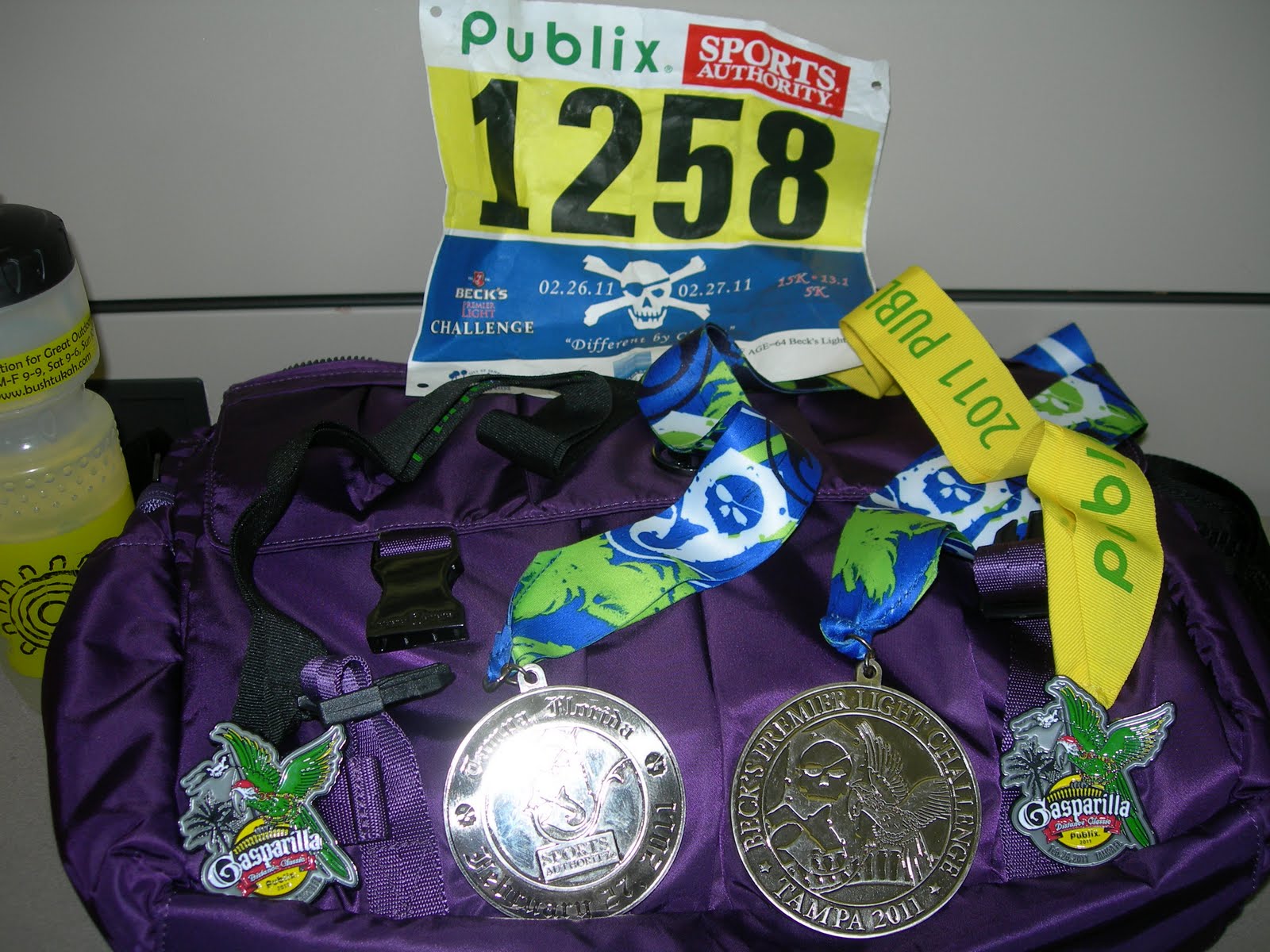
Report from the Gasparilla Race Weekend


I am writing this race report because I can't walk anywhere on the saucer-sized blisters on the balls of my feet. (Apparently too large running shoes are just as bad as too small.)

The fire ant bites on the other side of my feet are less swollen and itchy now. (It is not a good idea to wear sandals in the sea grass duck watching at dusk.)

The flu which overtook me the day after flying to Florida has subsided.

And in spite of it all, yesterday in 80 degree weather, I completed the first ever Beck's Light Ultra - the 15k, 5k and 21k races at the longstanding Gasparilla Race Weekend along the Tampa Bay waterfront.

What matters is not the apparel (three different race shirts plus a Beck's Light fleece vest) - or the three clanking race medals plus a heavyweight Beck's Light medal - it's the fact that I got up at 4:30 a.m. and sweltered through, a week after the frigid Winterman in Ottawa.

I'd always said I'd quit rather than suffer, but apparently that's not the case. It's fun to still be surprising myself.

Thursday, January 13, 2011

A Breeze from the Wind-Swept Iles de la Madeleine


Last spring, my friend Kristin Goff said she was interested in doing a one-week Cruise and Cycle package up the St. Lawrence River from Montreal.
She signed up, sharing a cabin with our friend Lynn Campbell. I signed up, sharing a cabin with cycle tour veteran Lorne.
Following is a quick report on written on our trip from CTMA (www.ctma.ca):
Les Iles de la Madeleine (a.k.a the Magdalen Islands) are about 100 km north of Prince Edward Island in the middle of the Gulf of St. Lawrence. The archipelago is made up of a dozen islands, and six of them are linked by long, skinny sand dunes. (As described in the guidebook, the Islands take the shape of a half moon fishhook stretching across a distance of 65 km in a south-west/north-easterly direction.)
The postcards don’t do justice to the red cliffs, sand dunes, brightly painted houses and saphire water.
Jacques Cartier praised the landscape in 1534, and there was fishing and hunting for seal and walrus long before he arrived.
The large ferry boards in Montreal on the Friday, day 2 in the Gaspe and then days 3, 4 and 5 docked in Les Iles de la Madeleine, day 6 back in Gaspesie Peninsula, day 7 in Quebec City and then day 8 back to Montreal. A GPS map posted near reception shows where the boat is at all times.
The package includes cabin accommodation for seven nights, 14 meals on board, light lunches for the road, and transportation for one bike per passenger.
To sum up, the scenery was spectacular, the cycling fantastic, the ship exciting (we’d never been on a cruise before), and Les Madelinots (the people) helpful and gracious.
For example, we’re cycling down Rue Coulombe towards Micro Brewery a l’abri de la Tempete, when my bike goes clunk. As Kristin and I examine the chain, a white-haired woman in navy pants and t-shirt immediately comes running out of her house to help. She turns the bike upside down, determines the problem is a missing screw holding the pannier holder to the bicycle, which has caused the metal rod to jam into the chain. She opens her car trunk for her tool box of hundreds of screws, fixes the rod, and apologizes that the screw is not the right colour.
It was the same whenever we stopped to look at a map; people came over without being asked. 
2 .m. Meeting 1 in the Red Lounge. Fruit punch in plastic glasses, and a demonstration how to use the life jackets.
Shortly after boarding Friday afternoon in Montreal, we are tapping our feet and sipping margaritas as we sit in the lounge and watch through rain dappled windows as the ship sails past La Ronde and other Montreal landmarks towards Trois Rivieres. (There are traditional musicians on the ship all week; we’re never up late enough to watch them.)
Forgotten are the wrong turns and humidity as we sweated our way from Ottawa to the port of Montreal to weigh anchor.
Lynn and Kristin are housed in a Lilliputian interior bunk bed cabin with no storage, but a private toilet and shower. (One foot’s in the shower when you’re in the toilet.) We (I) anticipating space deficit have chosen an exterior cabin with a porthole, also bunk beds, but slightly larger. We have to share bathrooms and showers with the other passengers on our cabin row. It was dicey for a couple of days when the toilets on our row weren’t flushing and the shower wasn’t draining, but once things were back to normal it wasn’t so bad.
The boat has massive public areas, prompting Kristin to muse why they couldn’t have given a little more space to the cabins and less to the lounge areas.

5 p.m. Meeting 2. For English participants only.
A rum cocktail in a plastic glass.
We are on Madeleine Islands time for the trip; we set our watches (with difficulty) to the Atlantic time zone, an hour ahead.
The aimof the English get-together is to wish us a good time and to show the ship cares about les Anglophones.
C.T.M.A.has been offering these trips for nine years; this week is a record number of English-speakers(60) because of a group of 30 from Collingwood, Ont.
There are over 300 passengers on the boat altogether. Around 97 per cent of the crew of 100 are from Les Iles de la Madeleine, and the rest are from Gaspe. This spring, they have been taking English lessons, and we are invited to see the two best English speakers if we have any communication problems with the crew. They have a mission this year, we are told, to improve the English product.
When we booked our trip, we chose the 5:30 p.m. seating for dinner rather than 8 p.m. The dining room has white table cloths.
People are dressed neatly, but not the “formal” suggested in some of the literature. Because tables are for four, it is noted that passengers will be “coupled” at dinner.
Since we had our own table for four, we weren’t “coupled” with anyone else. We did meet other people over breakfast and lunch.
The dinners on the ship are consistently excellent, with two choices each time.
The first night choices were seafood pot-en pot or bison medallions in cognac sauce, with of course an appetizer and a soup, and a chocolate caramel mousse cake for dessert.
One night the meal was large fresh local lobster, with turnip maple soup and blueberry cake. It’s like sitting in a revolving restaurant to be sitting backwards as the scenery and occasional whale goes by.
7:45 p.m. Meeting 3. Cycling people.
10 a.m. Meeting 4. More specific, cycling people, separate meetings for English and French.
We are told that each day we will see a different part of the Islands, on a self-guided tour. At 10 a.m. on Sunday, and 8 a.m. other mornings, we will meet with Fanny, Sebastien or Celine of Bureau Vert et Mer Ecotourism who will explain the day’s itinerary and give us a lunch bag and if necessary a time we’ll be picked up to return to the ship.
Daily direction depends on the prevailing wind; they will drive us out, to return on our bikes with the wind at our back. If we want to buy cheese at Au Pied-de-Vent Cheese Factory at Havre-aux-Maisons, they will store it for us until we leave the ship.
We cycle the South Island Sunday, the East Islands Monday and the Central Islands Tuesday. Distances are modest. The South Island is a 35k itinerary, with an optional 20km additional tour of Bassin. The East Islands is 65 km, but with four possible pick-up points before the final destination, Grand Entree, and return to the ship by bus.
The Central Islands is about 20 km, through the villages of Fatima, Etang-du-Nord and Cap-aux-Meules.


The ship’s dining room is closed while we’re docked on Les Iles, and we eat dinner on the Islands. Ship breakfast is cafeteria style.
After the heavy dinner and meetings, we collapse on deck on plastic Adirondack chairs to chat, inhale the sea breeze and swivel our heads around the expansive horizon. That’s one big river. The clouds are still gray and sky overcast, but the rain stops.
I spend the first night sweating in my humid top bunk, listening to something rattling, and people talking non-stop on the deck outside the window. Throughout the night the ships foghorn blasts intermittently, and each time I push the illumination button on my watch to see what time it is, so I won’t miss the 6 a.m. whale watching on the foggy, rainy deck. A light outside our window ensures 24 hour illumination of our room.
I show up at 5:55 a.m. in my green rain jacket to find we’re behind schedule, and won’t reach whale territory for at least an hour.
There are some people sleeping under blankets on the soft two-seater cocoa brown comfy couches by the windows. Others perch with their styrofoam coffee cups on the white window sills and gaze hypnotically at the overcast sky, shoreline and water, all complementary shades of silver. It’s beautiful in an arctic kind of way, all cold tones of white and gray.
Yoga after breakfast was so popular a second class was added for 2 p.m. to accommodate overflow. Yoga again a few days later on deck in the sunshine was a real sun salutation.
11 a.m. Navigation Meeting, because Wheelhouse Tour cancelled because of fog.
3 p.m. Meeting 6. Highlights of the Islands briefing.
Red Lounge. Bagosse fruit wine, 35 % alcohol.
On Saturday afternoon the sun comes out and we all flock to the deck chairs on the top deck to watch the water. The breadth of the St. Lawrence is awesome.
Sunday night, the foghorn blasts into our window again, and we awake to a sea of tin gray, with no visibility beyond some choppy dark waves beside the boat. Before we left, Lorne asked if he should put the batteries in the bike lights. I said we wouldn’t be cycling after dark. I didn’t even think about cycling in day time fog, however my yellow and blue jersey is bright enough to function as a fog light.
Sunday morning we board a bus to the South Island so we can have the wind at our back. Pelting rain cuts short the sightseeing, and visibility, but the route crossing Havreaux-Basque Lagoon through sand dunes and roadside wild flowers and beaches was magnificent despite the rain.  
(When we loaded at the ship in Montreal, Lorne’s tire had a flat, and then it blew up, in a series of complications.
Because it was Sunday when we arrived, the Island bike shop was closed. Sebastien, the bike coordinator for the tour, loaned Lorne his personal bike for the day.)
Monday is a magnificent day, point to point along the East Islands, with the wind at our backs. Stop for a self-created lunch at Au Pied-de-Vent Cheese Factory, a melange of cheese curds, French bread, and huge “crazy cookies” from nearby Helene des Isles Bakery, plus the assortment of juice boxes, raisin and nut mix, granola bars, oranges and apples provided for cycling each day.
Dinner at Vieux Couvent Restaurant, in an old convent overlooking the water, where the food and the service are unexpectedly as stylish as downtown Toronto.
Tuesday no shuttle is necessary, because the Central Island is where the ship is docked. Stunning blue sky and sparkling water as we circle via the shoreline, eating our pannier lunch outside at La Cote, a public park overlooking L’Etang-du-Nord fishing harbour and its little shops selling kites, crafts and locally made souvenirs.
Wednesday, breakfast on the boat at 6:30 a.m. and then we board a bus at the Chandler dock forPerce, the town and the famous rock, 45 minutes away. Town is an artist colony, rock and Bonaventure Island are noted for thousands of Northern Gannets who nest there. Our tour guide is folk singer and musician LucieBlue Tremblay who serenades us as we return. Rain and fog, but that big rock is hard to miss.
After our visit to Perce Rock, there’s an announcement telling everyone to gather in the lounge for a compulsory meeting. We all mutter and joke with apprehension.
We’re told that a labour lock-out at the Port of Montreal will be preventing us from docking there Friday.
We’ll be docking instead at Trois Rivieres, and then bused back to Montreal.
We all line up to hand in our car keys so our cars can be moved out of the Montreal port building where we left them, to an outside site. Bikes will be transported to Montreal by trailer. There are separate lines for people with and without cars, and those going farthest after Montreal got first bus preference.  
Free wine at dinner for our inconvenience.

We arrive at Quebec City Old Port at noon Thursday, and spend a beautiful sunny afternoon. Kristin and I cycle on the Quebec City bike trail, well mapped, along the shoreline, not hilly, while Lorne and Lynn stroll around the Old City. Another fine dinner back on the ship, plus more complimentary wine.
At 11 p.m. our boat time, 10 p.m. Quebec City time, we watch a huge 400-years-of-Quebec-City light show projected on port buildings, and then at 1 a.m. our boat departs for Trois Rivieres.
Around 8 a.m. we leave the ship in Trois Rivieres and we and our luggage board buses for the two-hour drive back to Montreal.
The Islands are not surprisingly a bit like Newfoundland, a bit like P.E.I., a very relaxing escape.
The Iles de la Madeleine logo is a clothesline, and a fitting common image is an engraving of a barrel with a sail that carried Island mail to Nova Scotia in February 1910 when the Islands lost contact with the mainland because of a breach in the underwater telegraph cable. Just like now, when we had no Rogers service for our cellphones or BlackBerries.

Tuesday, October 21, 2008

A for Amsterdam


Goedemorgen from Amsterdam, time delayed after an internet-free two weeks.

Lorne and I were on a Netherlands cycle trip, but before and after we spent time in Amsterdam, and here are some of our memories of that time...

Amsterdam is named after the Amstel River in the 13th century. 200 years ago Amsterdam became the capital of the Netherlands.

We flew KLM Montreal-Amsterdam direct, with a KLM bus to take us each way from the Ottawa train station to Montreal. The KLM flights, food, service, were excellent (except for Kung Foo Panda as the in-flight movie).

We were waiting at the Ottawa train station with a tall older Dutch woman from Arnprior. When she saw us again at the airport, she beckoned for us to join her for the cart ride through the terminal to the departure gate. Wheeee.
Waiting for the flight, I hesitated at the snack bar over what kind of tea to order. The well-pierced teenage server with a ring in his lip told me, “Green tea. It’s the healthiest. Lots of antioxidants.”
At the Montreal airport there were footstools on some of the seats in the waiting area, making it easier to actually rest.
Aug. 26
With a headwind, we arrive a half hour early and are at the Ibis hotel by 7 a.m. Amsterdam time. It’s a very, very tiny room, but a short walk from the train station and handy to everything. The hotel is across from a two-storey bike parking lot with thousands of bikes, and because we’re near the train station, there are thousands more bikes for blocks around.
Weather is typical Amsterdam, cool, cloudy, drizzly.
Grazing walk around for snack bar meals including falafel and sushi (Louise) and herring sandwich, cheese sandwich and two Heinekins (Lorne).
Argentinian steak restaurants and shawarma places exceed all others.
Aug. 27

Take a city tour. Wait for the lift bridge to go down near the site of new central library built two years ago, and the Tower of Tears from centuries ago where women and children cried as men went to sea.
More cyclists than cars wait at the bridge, riders on spray painted bikes, wearing high heels, suits, dressed for work. Bike lanes, bike parking everywhere. New architecture as interesting as old, plus new uses for old shipping warehouses. There are more than 1300 bridges, many dating from the 1600s. It’s like Venice, only Amsterdam has moved on into the 21st century.

17th century botanic garden... “Skinny Bridge” built by two sisters living across canal from each other in 1670 and didn’t want to boat in... Floating flower market...

The bus tour includes a visit to a “Diamond Museum” which is like Amway. You get in there, and they lock the door of the room for 20 minutes while they try to sell you diamonds.


Touring the Diamond Museum we were the only English speakers (rest were Spanish) and on the canal boat,all but us were Russian.

In the afternoon we went to the Rijks Museum to see masterpieces by Vermeer, Rembrandt etc from the Dutch Golden Age, the 1600s, and the took a canal boat cruise. There are ferries that go back and forth every 12 minutes, for pedestrians and cyclists only, and they are free. Saw houseboats, tall ships, all kinds of boats.

There are 2,500 houseboats in the city, many illegal. They live year-round on the boats, paying the city a fee. Many have flower boxes and plants along the deck. One had a sign “See what a houseboat looks like inside” and they made some money.

The railings along the canals are there to prevent cars from going into the water, but there is still a special dredge unit only to get cars out of the canal.The railings are owned by the insurance companies, not by the municipal government.

The boat guide said there are 725,000 people in Amsterdam, 42 per cent of non-Dutch ancestry, and 50 per cent one-person families.

Walking back from the boat, we stopped for pannenkoeken (pancakes). Lorne had Appel (apple) and I had Kaas (cheese). My second choice would have been Citroen (lemon.)

Still no sun. It feels like Whitehorse in November to wake up in the almost dark and to continue that dullness all day. People dress in black and gray.The only splashes of color are the spray-painted pink and fluorescent orange bikes which stand out among the racks of black bikes, some dotted with leis or fake leaves for identification.

Aug. 28
Take the bus to Brussels an Antwerp. Just tell me why the “Manneken Pis”, the peeing boy fountain, is so popular there are crowds around it all the time. Hundreds of ‘boy’ souvenirs from chocolate suckers to bells and statues for your garden.
Had lunch of moules et frites (mussels) at a cafe overlooking Brussels’ beautiful main square.
Bus got caught in a traffic jam on the way to Antwerp because of a tunnel accident, and we sat still in traffic for hours, coloring our impression of Antwerp. Some old buildings, a long waterfront, and a McDonald’s handy as always when you need a bathroom.

Aug. 29
Spent the morning visiting the rosebush lined village of Watergang outside Amsterdam, home for 50 years to our friend Puck’s mother.
It’s a tiny, Thomas Hardy-like hamlet with sheep, ducks, roosters and a canal. She took us for a walk along the cobblestones by the water and we had lunch at the De Wetgmijzer restaurant beside the street. She says the small red clay roofed houses in Watergang now go for over $1 million because it’s so serene and yet 10 minutes by frequent bus from Amsterdam. She didn’t like the village back when her husband chose it, but she’s happy at 90 to be there now.

We leave Amsterdam for our bike trip and continue our exploration a week later...

Sept. 5
We visit the Jewish Historical Museum, part of a complex of four restored synagogues including the Portuguese Synagogue from the 1600s. (In 1492 Spain expelled its Jewish population. Many fled to Portugal but were forcibly baptized. More than 100 years later, descendants of those victims of the Inquisition who wanted to live as Jews began to arrive in Amsterdam. Since the Dutch Republic was at war with Spain, they called themselves “Portuguese Jews” to avoid being identified with the Spanish enemy.

Letting everyone in to the country in the 1600s was for economic reasons, but it set the precident for Dutch liberalness in future.

The synagogue was undamaged even in the 2nd World War and is an amazing building with giant brass chandeliers that hold 1,000 candles, the only lighting in the unheated building.

The historical exhibit includes moving paintings and drawings of the early days by artists of the time. There is an excellent oil painting of a poor, sad old Jewish man sitting on the stoop of his shop. It was so popular that prints were made, but the commentary said the Jewish community was upset and asked why a young, attractive, well-off Jewish person couldn’t have been portrayed instead.
--
We have also of course gawked curiously at the “dark” Amsterdam nightly information tours offered by a former prostitute. The sailors are gone; the area is safe, the pamphlet says. We walked past the street level windows illuminated by dark fluorescent light where women wearing little beckon men on the street. We saw several go in the adjoining door to be led to the back.

There are also lots of “coffee houses” which are marijuana cafes, where people sit on cushions in the windows and smoke from hookahs, and weed and seed shops selling cannabis lollipops, starter kits for plant growing etc.

Sept. 6
We walked the city all day, spending time in The Rembrandt House where he lived 1639-1656, until he went bankrupt.There was a list of his possessions and all has been re-created with furniture from the time, including the short box cabinet bed - because people sat up to sleep so the blood wouldn’t leave their heads.

The most impressive thing again about Saturday night in Amsterdam is that once again the sidewalks are full, the cafes are packed, the bike lanes are busy and there are almost no cars on the streets, just a few taxis.

Sept. 7

Sunday morning and rain and wind again, ignored by the many walkers and cyclists. We walk for the last time down the Bloedstraat Red Light District, with only a few lights on and windows occupied - an( unreciprocated) hopeful wave and smile to Lorne; down the Chinatown streets with notices in Dutch not to lean your bike on the windows, past the flea market stalls, with mostly African textiles, carvings and jewelry, and all the while the church bells chime across the city.

We walk from our hotel to the train station for our train ride to the airport, the end of two weeks without entering a car.

Tot Ziens (Goodbye) and Proost! (Cheers!)